








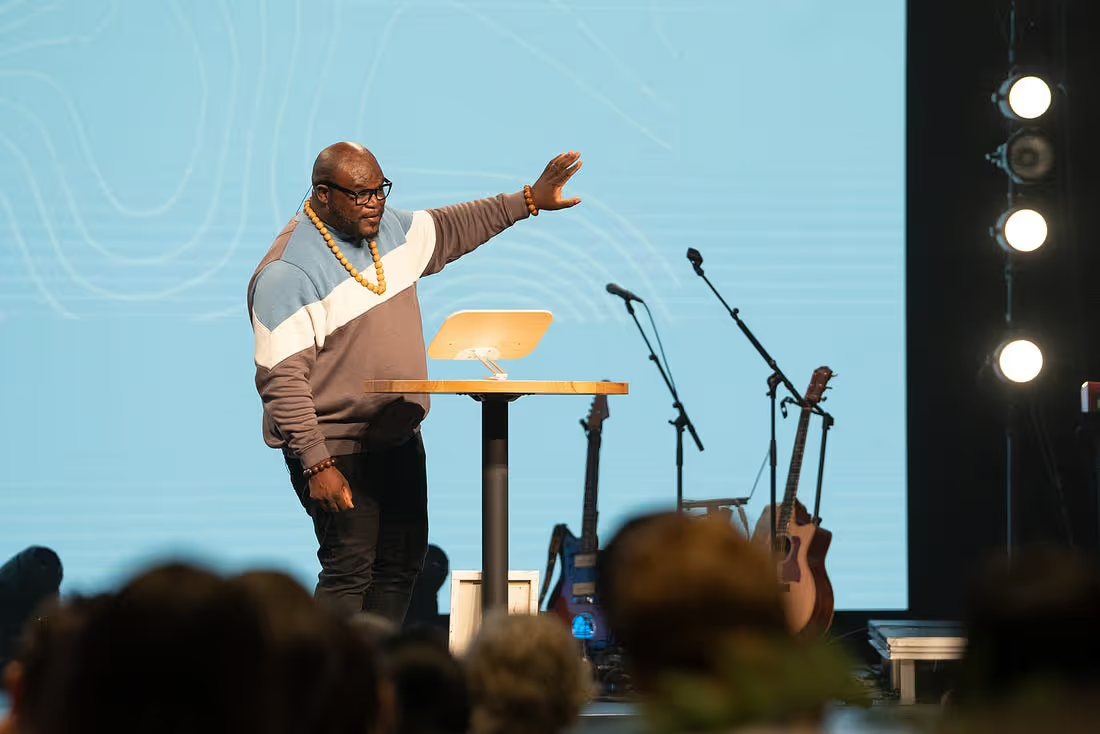
I was a little boy on the pews of a Black church in South Central L.A.—feet too short to touch the floor, hands full of crayons that never stayed inside the lines. But when the preacher got going, even the coloring stopped. He had that fire in his voice. That southern thunder that made your ribs rattle when he hollered truth. He would lean forward on the pulpit, pause just long enough to let the room settle, then shout:
“If God has redeemed you… SAY SO!”
And the whole church would erupt.
Somebody would stand. Somebody else would cry. A grandmother would wave a trembling hand in the air like she was fanning off the Holy Ghost.
And in that moment, you didn’t have to know what “redeemed” meant in the Greek. You just had to know that somewhere in your story, God showed up—and pulled you out.
It wasn’t about performance.
It wasn’t about church culture.
It was about truth.
And if the truth was that God saved you, delivered you, preserved you, transformed you—
then your job was to say so.
But Then I Grew Up
Now I’m grown. Now I know what it’s like to feel the cost of honesty. Now I know that saying so doesn’t always come with applause.
I remember working at a church where everyone walked on eggshells. Nobody gave honest feedback to the Pastor, not because he was right—but because of fear of his reaction. You could feel it in meetings. The silence wasn’t peace—it was fear dressed up in professionalism.
Then one day, I watched him speak harshly—publicly—to someone who didn’t deserve it. And everything in me knew it was wrong so I decided to SAY SO.
So I did.
I reminded him of our call as leaders. That our job wasn’t just to be excellent—it was to be like Christ. To be loving. To be gracious. And I said it knowing I might pay for it. And I did. But I’m still proud.
Not just in a pulpit. Not on a platform. But in a private moment where justice needed a witness.
What Saying So Actually Means
The psalmist in Psalm 107 isn’t giving us a suggestion—he’s giving us a directive:
“Let the redeemed of the Lord say so, whom He hath redeemed from the hand of the enemy.”
That little phrase—“say so”—carries weight. It means:
- Acknowledge that there is a God who redeems.
- That He doesn’t sit idly by while people suffer. That He moves toward the broken, the bound, the forgotten, and the abused.
- Acknowledge that He has redeemed you.
- That you’re not just telling Bible stories—you’re telling your story. That His grace has reached you, personally. Deeply.
- Acknowledge that He’s still redeeming—and you’re part of it.
- That you’re not just a recipient of God’s mercy—you’re now a participant in it. You’re not just thankful—you’re available.
When Saying So Costs Something
Saying so isn’t always clapping on beat in church. Sometimes it’s interrupting a harmful joke. Sometimes it’s standing up when someone’s dignity is on the line. Sometimes it’s calling out injustice in political systems, in church structures, in your own neighborhood.
Sometimes it’s choosing to identify with the poor, the immigrant, the hungry, the single mother, the prisoner, the Palestinian, the Black boy profiled again, the transgender teen kicked out of their house—not because you agree with every detail of their life, but because you believe in the God who still redeems.
That’s why Jonah didn’t want to say so. He knew if he opened his mouth, Nineveh would hear that God loves them too. And he didn’t want that.
He thought some people were outside of redemption.
Peter didn’t want to say so either—not when it might cost him something. So he said nothing. Actually, worse—he said, “I don’t know the man.” But silence does the same thing. When we shrink back, when we keep our redemption private, when we let injustice walk by unchecked—we deny Him, too.
The Evidence of Redemption
So here’s the real question: Are you saying so? Because the biggest sign that you’ve been redeemed isn’t just your praise—it’s your participation. Redeemed people say something. Redeemed people stand up. Redeemed people speak life and defend the vulnerable and push back against darkness. Your say so is supposed to stir up justice. It’s supposed to make room for healing. It’s supposed to remind the world that God still saves—and here’s proof: me.
Reflection Questions for the Road
- Where have you stayed silent because it was safer?
- What would it look like to “say so” in that exact place?
- Who have you excluded from redemption by withholding your witness?
- What does your silence say—and what could your voice start healing?